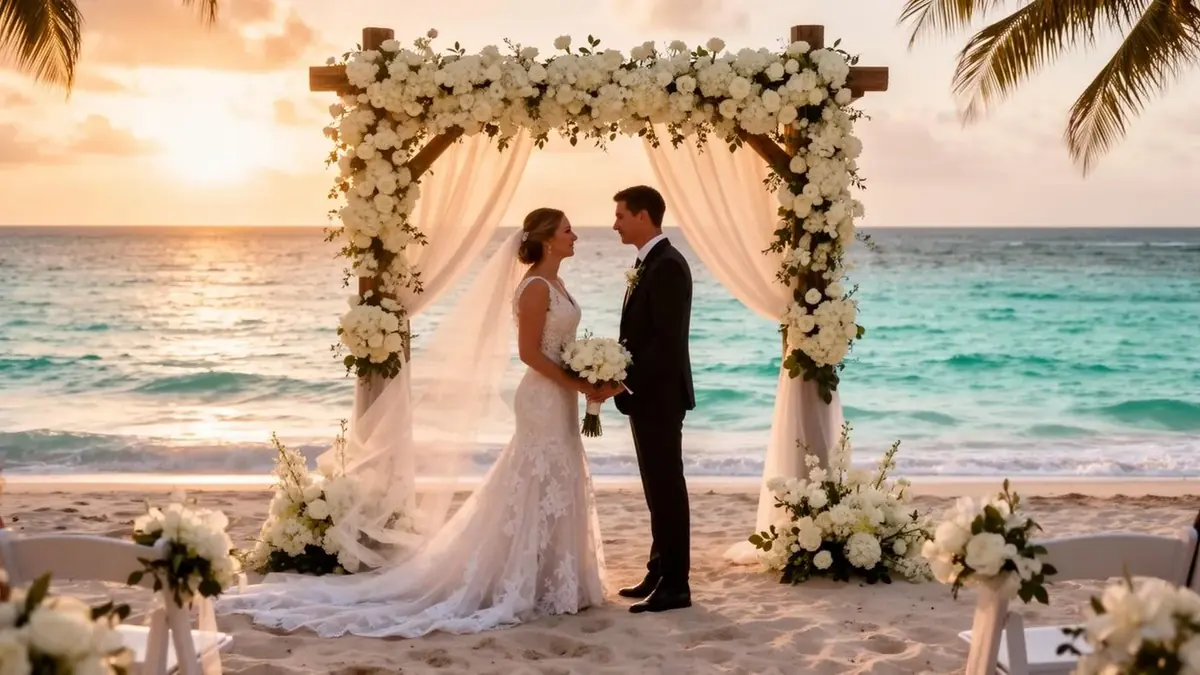
You picture it before you even know the destination. Salt air on a turquoise terrace at sunset. A small circle of the people you love most. A celebration that doesn't dissolve into seating-chart drama or a $90,000 invoice. That image — the one in your head right now — has a name, and it has rules, and it has a process that actually works when you follow it.
A destination wedding is a marriage ceremony held in a location away from the couple's hometown — typically a resort, beach, vineyard, or culturally significant venue that's also a vacation destination for guests. Most couples choose a Caribbean, Mexican, European, or Hawaiian setting, and most pair the wedding with a longer stay that doubles as the honeymoon. The format has grown sharply over the last decade because it tends to cost less, feel more intentional, and create memories that a hometown banquet hall simply can't.
In this playbook, you'll learn exactly what counts as a destination wedding, what doesn't, what it really costs in 2026, the timeline that prevents 90% of disasters, the destinations and resort brands that consistently deliver, the legal paperwork most couples don't find out about until it's too late, and the mistakes a seasoned wedding specialist watches couples make every single month. By the end, you'll know whether a destination wedding fits your life — and how to plan one that's beautiful instead of stressful.
What Counts as a Destination Wedding (And What Doesn't)
The term gets used loosely, so let's draw the line clearly. A destination wedding is any wedding that requires the majority of your guests to travel, stay overnight, and treat the event as a trip rather than a local errand. The defining factor isn't distance in miles — it's whether your celebration is also a journey.
The three formats most couples choose
The "destination wedding" label actually covers three distinct experiences, and the planning logic for each is different.
The all-inclusive resort wedding. The most popular format by a wide margin. You book a property with an in-house wedding team, choose a package (free up to ultra-premium), and the resort handles ceremony, reception, flowers, cake, photography, and officiant. Sandals, Beaches, Excellence, Secrets, Dreams, and Hyatt Ziva are the dominant brands. Guests stay onsite, eat and drink as part of their all-inclusive rate, and your logistics are radically simplified.
The villa or boutique-hotel wedding. You rent a private property — a villa in Tuscany, a boutique hotel in Provence, a private estate in Mexico — and bring in vendors. More design control. More personality. More effort. Best for couples with a clear aesthetic vision and a willingness to coordinate independent suppliers.
The cruise or river-cruise wedding. A small but rising category. You marry on board, or at a port stop, and the ship is your reception. Excellent for multi-generational guest lists where mobility varies. Itinerary-dependent and paperwork-heavy.
What doesn't qualify
A wedding in your hometown that happens to be in a "destination" city isn't a destination wedding — your guests aren't traveling. A weekend at a lakehouse 90 minutes from home is a great wedding; it's not a destination wedding. The distinction matters because the etiquette, budget, and timeline rules really do shift once travel becomes mandatory for the guest list.
The Real Pros and Cons of a Destination Wedding
Free: Sandals Resort Comparison Cheat Sheet
All 17 resorts compared side-by-side — budget tiers, overwater options, what's included, and booking tips. Print it. Share it. Plan your honeymoon with it.
Couples tend to hear about the upside online and discover the downside in a panic at month seven. Both sides deserve honest air time.
"The couples who love their destination weddings most are the ones who decided early what mattered — the people, the place, or the party — and then planned around that single anchor."
The pros that hold up under scrutiny
The guest list naturally rightsizes. Some people you'd feel obligated to invite to a hometown wedding politely decline, and you spend the day with the ones who really show up for you. Most couples report this as the biggest emotional win.
The cost usually drops. Average U.S. weddings now run $35,000 to $42,000 according to The Knot's most recent industry reporting; the average all-inclusive destination wedding lands closer to $10,000 to $20,000 for ceremony and reception, plus your own travel.
The honeymoon is built in. No frantic post-wedding flight. No second round of vacation planning. You wake up the next morning already in paradise.
Memories are layered. Guests share a multi-day experience — welcome cocktails, beach days, group dinners — instead of a four-hour reception. The relationships among your people deepen in ways a single evening can't replicate.
The cons couples wish they'd taken seriously
Some people you love won't come. Travel costs and PTO are real constraints, and you have to be at peace with the guest list you'll actually get rather than the one you'd ideally invite.
You give up some design control. Resort wedding packages mean working within the venue's preferred florist, photographer, and menu structure. If you have a specific Pinterest vision, a villa wedding gives you more freedom — and more work.
Logistics are concentrated. You can't visit the venue every weekend or run errands the morning of the ceremony. A trusted specialist and a great onsite coordinator are not optional. Talk to a specialist early if you want this part handled.
Weather and travel disruption risk are higher. A November Caribbean wedding faces hurricane-season tail risk; a January wedding in Europe means weather contingencies. Travel insurance and a Plan B aren't paranoia — they're planning.
Destination Wedding vs. Traditional Wedding — Side by Side
Couples often ask for a clean comparison before committing to either path. Here's how the two formats actually differ across the decisions that matter most.
| Factor | Traditional Hometown Wedding | Destination Wedding |
|---|---|---|
| Typical total cost (US, 2026) | $35,000–$80,000+ | $10,000–$40,000 (ceremony + reception) |
| Typical guest count | 100–200 | 20–80 |
| Planning timeline | 12–18 months | 10–14 months |
| Vendor coordination | You manage 8–15 vendors | Resort team handles most (all-inclusive) |
| Honeymoon | Separate trip after | Built into the same trip |
| Guest experience | One evening | 3–5 day shared experience |
| Design flexibility | High (you choose everything) | Moderate (resort) or High (villa) |
| Legal complexity | Standard state requirements | Country-specific paperwork |
| Weather risk | Moderate | Higher in tropical seasons |
| Best for | Big guest lists, deep local ties | Smaller circles, vacation overlap, simpler logistics |
The pattern is clear: traditional weddings give you maximum control with maximum cost and complexity. Destination weddings give you simpler logistics, lower cost, and a richer multi-day experience — at the price of design flexibility and guest count.
The Best Destinations for a Destination Wedding in 2026
Where you marry should match three things: the experience you want, the comfort level of your guest list, and the legal reality of getting married in that country. These five regions consistently deliver for the couples we work with.
Caribbean — the workhorse choice
Jamaica, the Bahamas, Saint Lucia, Antigua, Barbados, Grenada, and Turks & Caicos dominate the Caribbean wedding market for good reason. Flight access from the U.S. East Coast and Midwest is straightforward, all-inclusive brands are well established, English is the working language in most properties, and legal paperwork is well-trod. Sandals operates 15+ resorts across the region with a free wedding package and complimentary symbolic ceremonies. Beaches (the family-friendly Sandals sibling) is the strongest option when guests will travel with children. Expect starting-from rates in the $250–$700 per person, per night range for the wedding party at premium all-inclusives.
Mexico — the design and value sweet spot
The Riviera Maya, Los Cabos, and Puerto Vallarta have become arguably the most flexible destination wedding markets in the world. Massive resort inventory across Excellence, Secrets, Dreams, Hyatt, Hard Rock, and independent properties. Strong vendor ecosystem for couples who want to layer in a private florist or band on top of a resort base. Legal civil weddings in Mexico are possible but paperwork-heavy — most U.S. couples marry legally at home and host a symbolic ceremony in Mexico (the photos and the celebration are identical; only the certificate-signing happens stateside).
Europe — the design statement
Italy, France, Greece, Portugal, and Spain remain the gold standard for couples who want their wedding to feel like a film. Tuscany villas, Amalfi Coast hotels, Mykonos cliffsides, Lisbon palaces, and Mallorca estates each deliver a distinct visual identity. Costs run higher than the Caribbean, paperwork is more complex (especially Italy and France), and the season is concentrated May–September. Best for couples who care more about aesthetic specificity than guest-list size or simplicity.
Hawaii — the no-passport option
Underrated for couples whose guest list includes people who don't have passports, can't fly internationally, or are managing tight PTO. Maui, Kauai, and the Big Island offer beach, garden, and mountain venues. U.S. legal requirements apply, so paperwork is straightforward. Costs trend higher than the Caribbean because Hawaii pricing is closer to mainland U.S. luxury.
Sample "Starting From" Pricing — 2026 Snapshot
| Region | Wedding package starting at | Per-night for guests starting at | Notes |
|---|---|---|---|
| Caribbean (Sandals/Beaches) | $0 (free) – $5,500 (premium) | $250 pp/night | English-speaking, paperwork familiar |
| Mexico (Excellence/Secrets) | $1,500–$6,000 | $200 pp/night | Symbolic ceremony common |
| Italy (villa) | $15,000+ venue | $300–$800/room | Legal civil marriage possible |
| Greece (Mykonos/Santorini) | $10,000+ venue | $400–$1,200/room | Apr–Oct season |
| Hawaii (Maui/Kauai) | $5,000–$12,000 | $400–$900/room | No passport required |
Prices are illustrative starting-from estimates and shift seasonally. A HoneymoonGuru specialist builds a real quote against your dates, guest count, and resort tier.
How Much Does a Destination Wedding Actually Cost?
The honest answer: it depends on three variables — venue type, guest count, and how much design layering you want on top of the resort package. Here's how to budget realistically.
The four budget tiers
Tier 1 — Free or near-free package, $3,000–$8,000 total. Sandals or Beaches with their complimentary symbolic wedding package, 10–20 guests, no design upgrades. Your real out-of-pocket is mostly your own honeymoon stay. This is the most underrated path in the industry.
Tier 2 — Standard package, $10,000–$18,000 ceremony and reception. All-inclusive resort, 30–50 guests, a step up in flowers, photography, and a private reception dinner. The most common tier for couples we work with.
Tier 3 — Premium resort with upgrades, $20,000–$40,000. Excellence Riviera Maya or a premium Sandals overwater suite, 40–80 guests, custom floral, upgraded photography, welcome event, farewell brunch.
Tier 4 — Villa or European luxury, $50,000–$150,000+. Tuscany or Amalfi villa rental, full vendor team, multi-day programming. Smaller guest list but no cost ceiling.
What surprises couples most
Travel insurance for the couple. Marriage license fees and translator/notary costs in non-English countries. Welcome bags and transportation between airport and resort if you're hosting it. Tipping the wedding coordinator and resort vendor team (budget 15–20% on top of package fees). Hair and makeup trial separate from wedding-day services.
"Build a 10% contingency line into your destination wedding budget. The couples who don't usually borrow from it anyway — the ones who do feel calmer the whole way through."
The 12-Month Destination Wedding Timeline
Most stress in destination wedding planning comes from couples treating it like a hometown wedding and discovering at month four that the rules are different. Follow this timeline and the process largely manages itself.
12 months out
Pick your destination, your resort or venue, and your dates. Lock the room block so your guests can begin booking. Send a save-the-date — earlier than a hometown wedding because guests need to book travel and request PTO. Start the legal-paperwork research for your country.
9–10 months out
Send formal invitations with a dedicated wedding website (resort details, room block link, suggested flights, packing notes, activities). Lock your wedding package tier and submit any customization requests. Book your photographer if you're bringing one or upgrading from the resort default.
6 months out
Schedule a venue site visit if budget allows — even one night onsite changes how you plan. Begin gathering legal documents (apostilled birth certificates, divorce decrees, passport copies). Finalize the welcome event and farewell brunch.
3 months out
Final headcount lockdown. Menu and floral selections submitted. Group flight options consolidated for guests who haven't booked. Vendor calls scheduled.
1 month out
Confirmations on every line item with the resort. Welcome bags assembled and ready to ship or carry. Tipping envelopes prepared. Travel insurance final review.
Wedding week
You arrive 3–5 days before the ceremony. Day-of timeline walked with the onsite coordinator. Legal paperwork signed. The rest is presence, not planning.
How to Choose Your Resort or Venue
The venue decision is the most consequential one you'll make. These are the filters our specialists apply, in order.
Filter 1 — Guest list reality
If your guest list includes children, you need a property that welcomes them with infrastructure — Beaches Resorts, Hyatt Ziva, Excellence (kids welcome only at certain properties), and Dreams are the strongest choices. If your guest list is adults-only, you unlock the entire Sandals portfolio, Secrets, Excellence adults-only properties, and the boutique villa market.
Filter 2 — Wedding experience flow
Visit the resort's wedding page and look for three things: a dedicated wedding coordinator (not a "concierge who also does weddings"), at least three real ceremony locations on property, and the ability to host a private reception dinner separate from main restaurants. If any one of those is missing, the wedding will feel rushed.
Filter 3 — Suite category for the couple
You want a suite that gives you space to get ready, host a small toast, and decompress after the ceremony. Beachfront or rondoval suites at Sandals, Imperial Junior Suites at Excellence, and Preferred Club suites at Secrets all clear that bar. Skip the entry-level room categories for the couple themselves.
Filter 4 — Reach to the airport
A two-hour airport transfer kills the vibe for older guests and parents with kids. Properties within 30–45 minutes of an international airport hold up better for multi-generational guest lists. Saint Lucia (UVF) and some Riviera Maya properties test this filter; Montego Bay, Cancun, Nassau, and Punta Cana mostly pass it.
A note on Sandals and Beaches for destination weddings
Sandals invented the free wedding package and remains the most efficient choice for English-speaking, Caribbean, adults-only destination weddings. Beaches Resorts (the family-friendly sister brand) is the strongest option in the all-inclusive market when guests will travel with children. HoneymoonGuru specialists are certified Sandals and Beaches experts and can frequently secure value-adds — credits, room upgrades, private dinners — that aren't visible at the consumer booking level. Talk to a specialist to see what's available on your dates.
Guest Etiquette — Invites, RSVPs, and Realistic Expectations
The etiquette around destination weddings differs from hometown weddings in three meaningful ways. Get these right and your guests feel respected; get them wrong and the resentment lingers.
Invite earlier, not louder
Save-the-dates should land 10–12 months ahead of the wedding (vs. 6–8 for a traditional wedding). Formal invitations 6–8 months out. The earlier your guests know, the more likely they can budget, request PTO, and actually show up.
Don't expect 100% attendance
A 65–75% RSVP rate for destination weddings is normal and healthy. Some people will say no for cost, kids, work, or health reasons. Don't take it personally. Send a beautiful gift and a heartfelt note to the ones who can't make it, and put your full presence with the ones who do.
Don't fund guest travel — but do remove friction
You're not obligated to pay for guests' flights or rooms (in fact, doing so subtly changes the social contract in ways that often backfire). What you are obligated to do is make it easy: a dedicated wedding website, a room block with negotiated rate, suggested flights, ground transfer instructions, a packing list, and a clear schedule of optional events.
Plan one event guests can opt into and one they can opt out of
A welcome cocktail night that everyone attends. A beach day where guests are free to do their own thing. The pacing matters — guests need shared moments without feeling chaperoned for 96 hours straight.
Legal Requirements — The Paperwork That Catches Couples Off Guard
Every country has its own marriage rules. Here's a high-level snapshot of the most common destinations. This isn't legal advice — confirm with your resort coordinator and an immigration or family attorney for your specific situation.
- Jamaica — Must be in country 24 hours before the ceremony. Need passport, birth certificate, and (if applicable) divorce decree or death certificate of prior spouse. Cost roughly $250–$350 in fees.
- Bahamas — Same 24-hour rule. Sworn declaration in front of a Bahamian notary. Documents needed: passport, birth certificate, divorce/death paperwork if applicable.
- Mexico — Civil marriage is legal but paperwork-intensive (blood tests, translated documents, in-country witnesses). Most U.S. couples marry legally in the U.S. before the trip and have a symbolic ceremony in Mexico. The photos and emotional weight are identical.
- Italy and France — Civil marriage is legal but requires multiple weeks of in-country presence and apostilled documents. Many couples do the legal U.S. step beforehand.
- U.S. (Hawaii, Florida Keys, Puerto Rico) — Standard state marriage license. Simplest paperwork for U.S. couples.
The pragmatic move for most American couples: handle the legal civil marriage at home before traveling, then host a symbolic ceremony at your destination. You're legally married in the eyes of the U.S. government, your destination event is the celebration you wanted, and your wedding photos look exactly the same.
Mistakes a Wedding Specialist Sees Couples Make Every Month
The same handful of avoidable mistakes show up over and over.
Booking before securing the room block. Once your guests start booking individually, prices rise and you lose group benefits. Lock the block first, then send save-the-dates.
Underestimating shoulder-season risk. September and October in the Caribbean are gorgeous when they're gorgeous and disastrous when they're not. If you marry in hurricane season, budget travel insurance and a Plan B venue you can shift to.
Treating "free package" as the only choice at Sandals. The free wedding package is legitimately excellent for couples who want simplicity. But for 40+ guests or premium floral, the paid tiers offer real upgrades. Choose with intention.
Skipping the site visit. A single night at the property changes every subsequent decision. If it's logistically possible, go.
Letting the design wishlist outrun the venue's vendor list. All-inclusive resorts have preferred vendors for good reason. If you want a specific floral designer, photographer, or band, choose a villa wedding from the start — don't try to retrofit a Pinterest board onto a resort wedding.
No travel insurance. A destination wedding is a non-refundable, non-rebookable event for most couples and their guests. Travel insurance is not optional.
Ready to Make It Real?
A destination wedding is one of the few life events where doing less of the work actually produces a better experience. The couples who end up with the wedding they pictured aren't the ones who tried hardest — they're the ones who picked the right destination, the right resort, the right specialist, and then let the system do its job.
If you're starting to imagine where and how, the next step is a real conversation with someone who's planned hundreds of destination weddings and knows which resorts deliver, which dates to avoid, and which value-adds to ask for.
Want to talk to a guru? Connect with a live wedding-planning professional about your destination wedding — same warm, no-pressure conversation, same form, real human on the other side.
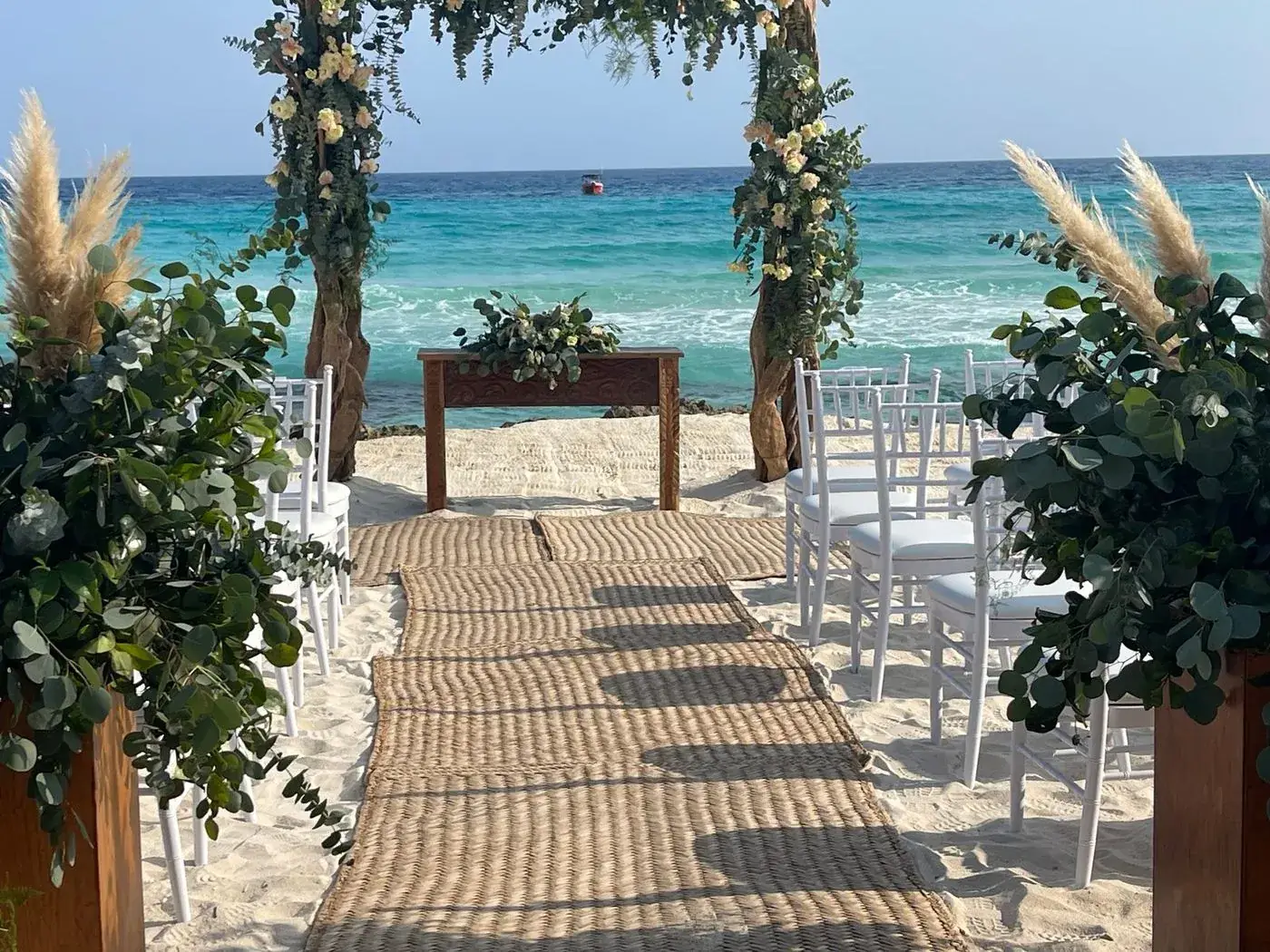
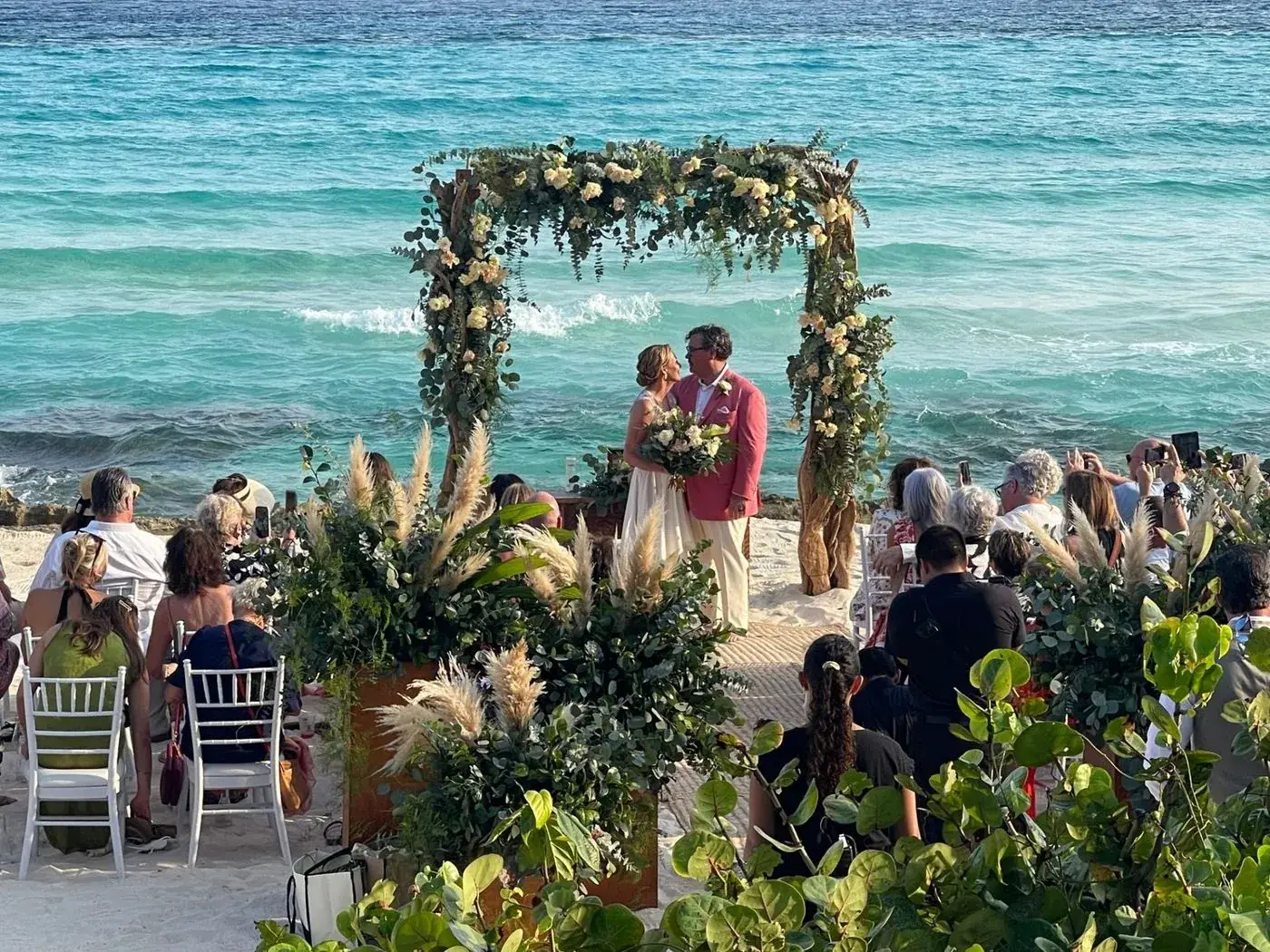
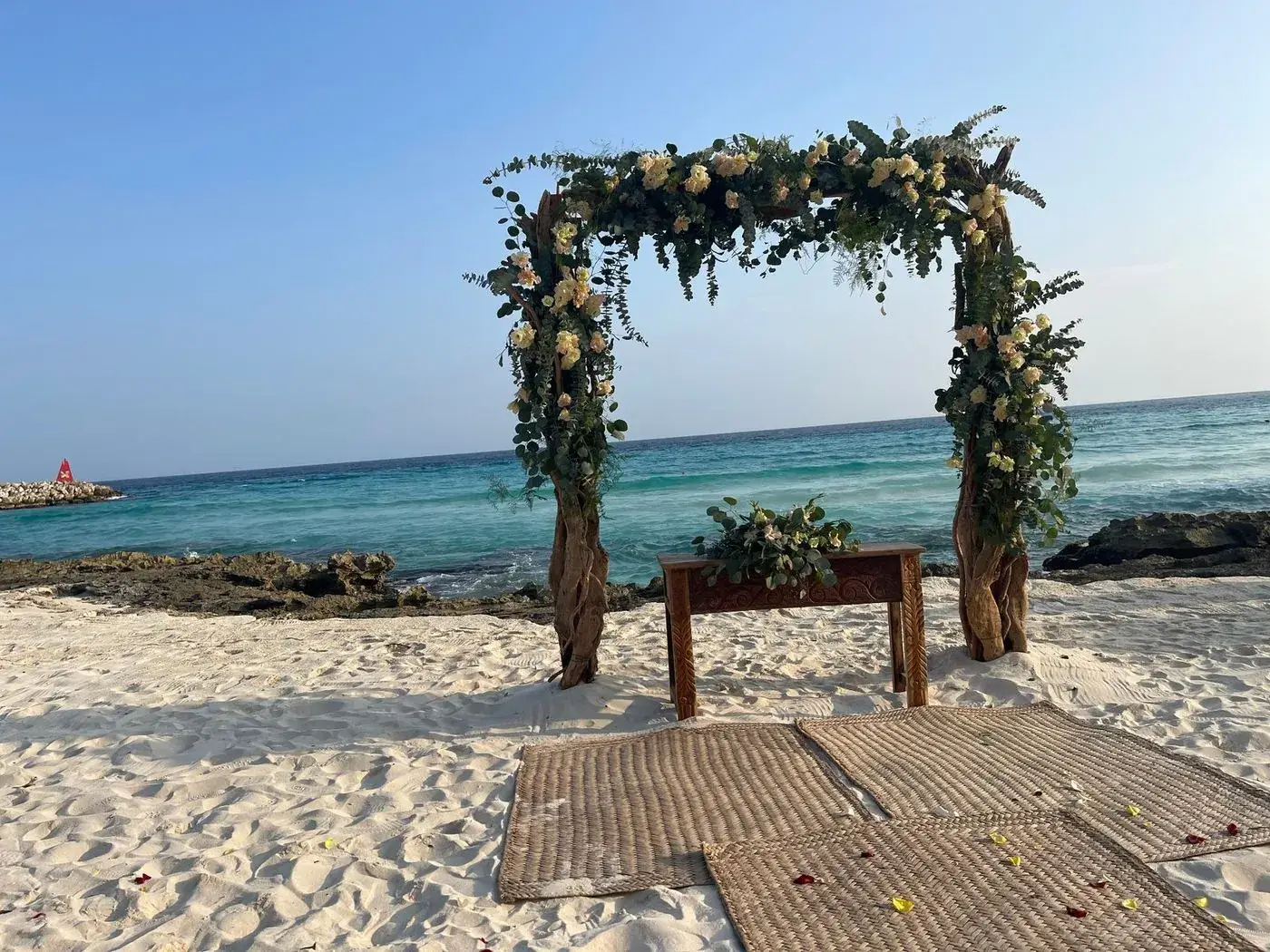
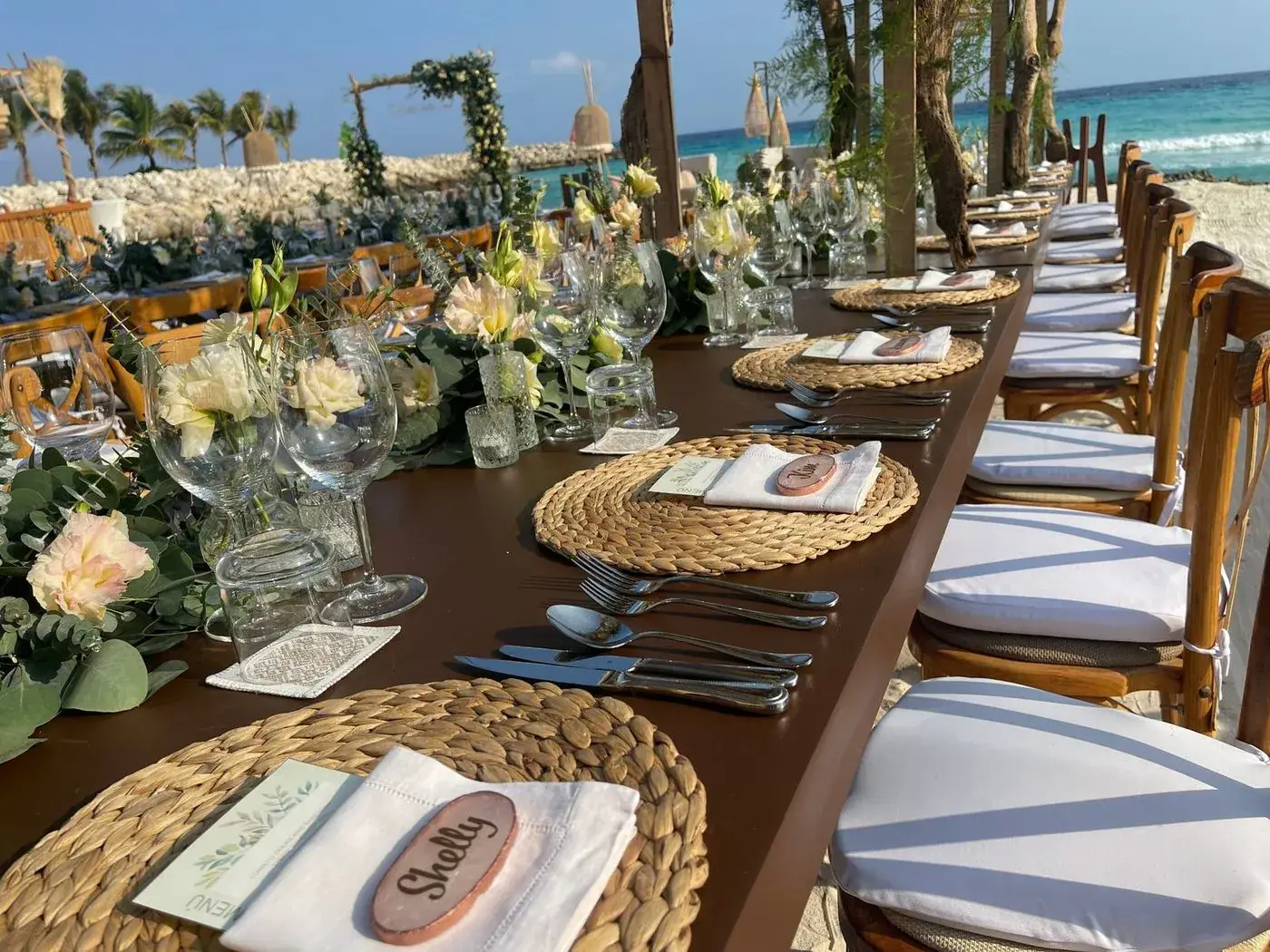
Real ceremony and reception from a Caribbean beachfront destination wedding.
Frequently Asked Questions
Are destination weddings cheaper than traditional weddings?+
Usually, yes. The average traditional U.S. wedding ran $35,000–$42,000 in The Knot's most recent industry reporting, while typical all-inclusive destination weddings (ceremony plus private reception) land in the $10,000–$20,000 range. Add your own travel and a buffer, and most destination weddings still come in well below a comparable hometown event — especially when you factor the built-in honeymoon.
How far in advance should you book a destination wedding?+
Plan on 12 to 14 months. That gives you time to lock the venue and room block, send save-the-dates 10–12 months out, gather legal paperwork, and let guests budget for flights and PTO. Last-minute destination weddings are possible (some Sandals weddings can be arranged in 60–90 days) but you'll have fewer suite categories and date options.
Who pays for a destination wedding — the couple or the guests?+
The couple traditionally pays for the ceremony, reception, and any couple-hosted events. Guests pay for their own flights and rooms. You're not obligated to subsidize guest travel, but you are responsible for making the logistics frictionless — wedding website, negotiated room block, ground transportation instructions, and clear schedule of events.
Can you legally get married in another country?+
Yes, but the paperwork varies dramatically by country. Jamaica, the Bahamas, and Saint Lucia have well-trod processes. Italy and France require multiple weeks in-country. Many U.S. couples sidestep the complexity by doing the legal civil marriage at home and hosting a symbolic ceremony at the destination — the celebration is identical and the photos look exactly the same.
How many guests typically attend a destination wedding?+
Most destination weddings host 20 to 80 guests. The average is around 40–50. RSVP rates of 65–75% are normal — some people you'd want to invite will decline for cost, PTO, or family reasons. The smaller guest list is often cited as the single biggest reason couples loved their destination wedding.
What's the best month for a Caribbean destination wedding?+
January through April delivers the most reliable weather and the lowest hurricane risk, with prices peaking around February. Late April, May, and early June are excellent value windows with strong weather. September and October are the highest hurricane-risk months — possible to plan around, but require travel insurance and a backup plan.
Should I use a wedding specialist or book directly?+
A specialized destination wedding planner adds value in three ways: securing room blocks and upgrades that aren't visible at the consumer level, navigating resort wedding packages and contracts, and managing logistics for 30–80 guests booking independently. The specialist's fee is usually paid by the resort, not you. For destination weddings specifically, the coordination value is substantial.
Done researching? Have an expert double-check your pick.
A honeymoon specialist can confirm live availability and perks for your dates — free, no obligation.
Talk to a Guru — Free